
The most prestigious material for your dining room might be the very thing that stops you from truly enjoying it. We all admire the cool touch and unique veining of natural stone, but the decision between a real vs faux marble dining table often comes down to how you actually live in your home. It’s natural to feel torn between the prestige of quarried marble and the worry that a single spill will ruin a significant investment. You want a space that feels like a sophisticated sanctuary, not a museum where guests are afraid to set down a drink.
This guide helps you settle the debate by exploring how 2026 design trends have elevated modern materials like ceramic to new heights of style. You’ll discover the definitive differences between natural stone and high-performance alternatives to find the perfect blend of luxury and practicality. We’ll look at durability, maintenance, and the latest curved silhouettes to ensure your new table remains a stunning focal point that handles family life with ease and grace. By the end, you’ll have the confidence to choose a piece that serves as a beautiful foundation for years of connection.
Key Takeaways
- Discover the structural differences between natural metamorphic rock and sintered ceramic to understand how weight impacts your room’s layout and logistics.
- Learn why the ‘Lemon Test’ is a critical benchmark for durability and whether your chosen surface can truly handle hot pots and daily spills.
- Master the art of styling a real vs faux marble dining table by matching intricate veining patterns with modern pedestal or four-leg frames.
- Evaluate the long-term investment value of each material, weighing the initial purchase price against maintenance needs and future resale appeal.
The Allure of Marble: Why Natural Stone and Faux Alternatives Lead 2026 Trends
In many homes across Ireland, the dining table is more than a place to eat; it’s the heart of the household. It’s where we work, celebrate, and gather for long Sunday lunches. Marble has long held a psychological grip on our design sensibilities because it represents a connection to the earth that feels both permanent and profoundly luxurious. Its organic patterns offer a visual rest that synthetic, repetitive designs simply can’t mimic. Choosing between a real vs faux marble dining table isn’t just about price. It’s about deciding how you want your home to feel during those quiet morning coffees and busy evening gatherings.
The Timeless Elegance of Natural Marble
Every piece of natural stone tells a story that began millions of years ago. When you touch a marble surface, you’re feeling a unique geological masterpiece that no one else in the world owns. To truly understand What is Marble?, one must appreciate its journey from limestone under intense heat and pressure into the crystalline structure we admire today. This material science results in a sensory experience that defines high-end living. The characteristic chill of the stone and its substantial weight create a sense of presence in a room. For centuries, it has served as a status symbol, yet it remains remarkably versatile, fitting into a minimalist city apartment as easily as a traditional country home.
The Rise of High-Performance Faux Marble
The word ‘faux’ used to carry a bit of a stigma, often associated with flimsy plastic laminates that looked cheap and felt worse. That era is over. As we move through 2026, manufacturing technology has advanced so far that high-end engineered ceramics are often indistinguishable from their quarried counterparts. These modern alternatives, often referred to as sintered stone or ceramic marble, are designed for ‘lived-in’ luxury. They offer the same striking veining and polished finishes but are engineered to withstand the rigors of a busy family life. The shift toward these materials reflects a growing desire for homes that look like a magazine spread but function like a real living space. In professional design circles, ‘faux’ is no longer a dirty word; it’s a smart choice for those who prioritize durability without sacrificing the aesthetic.
Deciding between these two paths depends on your personal philosophy of home. If you view a dining table as a legacy piece that should age with the house, natural stone offers an unmatched soul. However, if you need a surface that can handle homework, wine spills, and heat without a second thought, the modern ceramic alternative provides peace of mind. Both options lead the 2026 trends because they prioritize beauty and organic textures. Comparing a real vs faux marble dining table allows you to weigh aesthetic purity against modern performance requirements to find the right fit for your lifestyle.
Material Science: Comparing Real Marble vs Ceramic Faux Marble
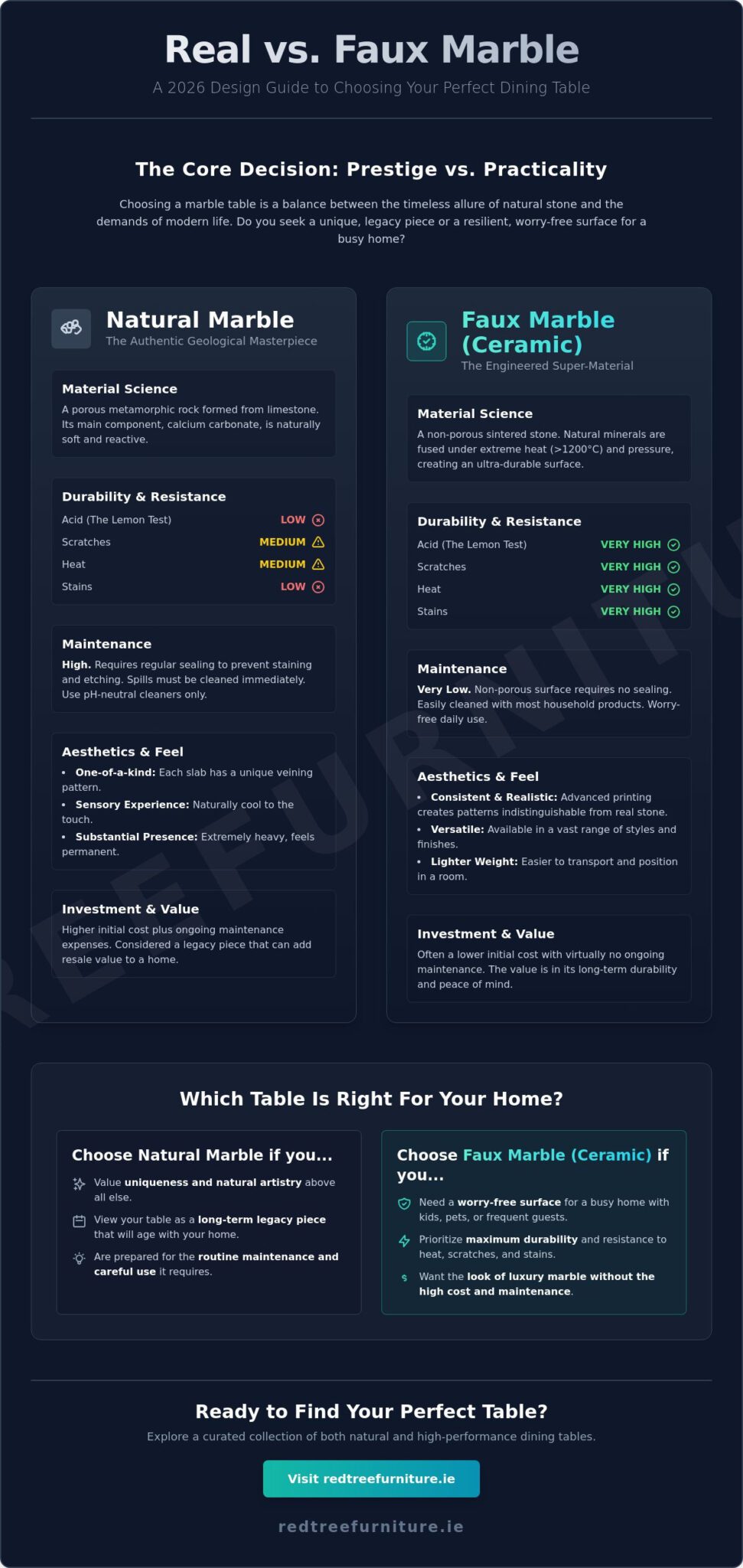
Understanding the fundamental differences between these materials helps you move beyond surface-level aesthetics. While both options offer a striking look, the way they are formed dictates how they behave in your home. Real marble is a metamorphic rock, created over millennia as limestone is subjected to intense heat and pressure within the earth’s crust. In contrast, high-end faux marble is often made from sintered ceramic. This involves a precise, human-led manufacturing process where natural minerals are pressed together at incredibly high pressures and baked at temperatures exceeding 1200 degrees Celsius. This mimics the earth’s natural cycle but does so in a fraction of the time with far greater control over the final result.
Natural Marble: A Porous Geological Wonder
The beauty of natural stone comes from its organic origin, but this also means the material is naturally porous. Think of it as a surface that ‘breaths’ through microscopic channels. This structure is why the Natural Stone Institute emphasizes the importance of proper sealing. Popular varieties like the soft grey-veined Carrara or the bold, dramatic Calacatta are primarily composed of calcium carbonate. This chemical makeup makes them highly reactive to acidic substances. If you spill lemon juice or vinegar on a real marble surface, a chemical reaction called etching can occur, dulling the finish almost instantly. It’s a material that requires respect and a bit of a gentle touch.
Ceramic Marble: The Engineered Super-Material
When people search for a real vs faux marble dining table, they’re often surprised to learn that ceramic dining tables have become the gold standard for modern alternatives. Unlike older laminate versions, sintered ceramic is non-porous. The manufacturing process creates a surface with near-zero absorption, meaning red wine or coffee can’t penetrate the material. On the Mohs scale of mineral hardness, natural marble typically sits around a 3 or 4, making it relatively easy to scratch with a metal knife. Ceramic, however, often ranks between a 7 and 9. It’s so hard that you’d likely dull your kitchen knives before you managed to leave a mark on the tabletop. If you’re looking for that classic look with a more resilient finish, you might want to browse our collection of marble dining tables to see how these materials compare in person.
Another key distinction lies in the visual depth and physical weight. Real marble slabs are incredibly dense and heavy, often requiring reinforced flooring or professional white-glove delivery to ensure they’re positioned safely. Because the pattern goes all the way through the stone, any edge profile you choose will show the same beautiful veining. With ceramic, the pattern is often high-definition surface printing. While the newest 2026 designs now offer ‘through-body’ veining that mimics the natural look even on the edges, the slabs are typically thinner and lighter than solid stone. This makes them much easier to move if you decide to rearrange your dining space, yet they remain remarkably sturdy for daily use.
Durability and Maintenance: The Reality of Daily Dining
When you’re hosting a Sunday roast or a Friday night wine evening, the last thing you want is to be hovering over your guests with a coaster. The real-world performance of a real vs faux marble dining table becomes apparent during these lived-in moments. While both look stunning in a showroom, one requires a vigilant eye while the other lets you relax and enjoy the conversation. The choice often hinges on whether you view maintenance as a therapeutic ritual or a burdensome chore.
A simple drop of lemon juice or a splash of white wine can be the ultimate test for any tabletop. On real marble, these common household acids eat into the calcium carbonate surface almost instantly. This isn’t a simple stain that can be scrubbed away; it’s etching. It leaves a dull, cloudy mark that alters the texture of the stone itself. If you prefer your furniture to look brand new for decades, the ‘as-new’ resilience of ceramic might be more your speed than the evolving ‘patina’ of natural stone.
The High-Maintenance Reality of Natural Stone
Real marble is a commitment. It’s like owning a luxury car; it needs regular servicing to stay in peak condition. You’ll need to apply a high-quality sealer at least every six months to keep the pores closed and prevent permanent staining. Even with a sealer, you must follow the golden rule of stone care: blot, don’t wipe. Wiping a spill spreads the liquid across the surface and pushes it deeper into the microscopic channels of the rock. Over time, the cost of professional sealing products and the potential need for specialist restoration can add up, making the lifetime cost of ownership higher than the initial price tag suggests.
Life-Proof Luxury: The Case for Ceramic Faux Marble
Ceramic has emerged as the ultimate choice for contemporary dining furniture Ireland families rely on for daily use. It’s virtually bulletproof. Because the material is fired at such extreme temperatures, it possesses incredible thermal shock resistance. You can often place a hot serving dish directly on the surface without fear of cracking, though we still suggest using a mat to protect your cookware. Cleaning is a breeze, usually requiring nothing more than a damp cloth and a bit of soapy water.
In the chaos of a busy home, impact resistance is just as important as stain resistance. While natural marble can chip or crack if a heavy pot is dropped on its edge, high-end ceramic is engineered to handle these domestic accidents with ease. It provides a sense of life-proof luxury that allows your dining room to be a functional workspace and a play area without sacrificing its sophisticated aesthetic. When weighing up a real vs faux marble dining table, consider how much time you want to spend protecting your investment versus simply enjoying it.
Aesthetic Versatility and Styling Your Dining Space
Styling is where the technical decision between a real vs faux marble dining table transforms into a personal design statement. Once you’ve considered the durability of the material, you can focus on how the piece anchors your room. A marble surface, whether natural stone or high-end ceramic, acts as a canvas for the rest of your decor. The key to a successful 2026 interior is balance. You want to pair the cool, architectural feel of a stone top with warmer, softer elements to create a space that feels inviting rather than clinical. Mixing textures is essential; try placing a sleek ceramic table against a textured wallpaper or a soft wool rug to create a sophisticated contrast.
Lighting plays a vital role in how your table is perceived throughout the day. Both natural marble and polished ceramic have reflective qualities that can brighten a dim room. During the day, natural light highlights the depth of the veining. In the evening, a low-hanging pendant light creates a warm glow on the surface, making the table the undisputed centerpiece of the home. Consider the base design as carefully as the top. A pedestal base offers a sculptural, modern look that maximizes legroom, while a traditional four-leg frame in matte black metal or warm oak provides a grounded, timeless feel.
Choosing the Right Marble Pattern for Your Room
The intensity of the veining should match the energy of your home. Bold, dramatic patterns with thick charcoal or gold veins work best as a singular focal point in a minimalist room. If your space already has busy patterns or lots of artwork, a more subtle, mottled grey pattern will provide elegance without competing for attention. Shape also influences the visual flow. A round table with a continuous pattern flow encourages conversation and softens the lines of a square room. Rectangular tables, however, allow for long, sweeping veins that draw the eye across the space, making a dining area feel more expansive and grand.
Completing the Look: Chairs and Storage
Your choice of seating can completely change the personality of your table. Selecting dining chairs that complement marble aesthetics often involves playing with material contrast. Velvet chairs in deep forest green or navy add a layer of luxury and comfort that balances the hard surface of the stone. To keep the room from feeling too ‘top-heavy’ with stone, coordinate your table with a wooden or lacquered sideboard to distribute the visual weight. A sleek ceramic top creates a foundation for a stylish life, offering a polished look that remains effortlessly chic regardless of how many times you restyle your accessories. If you’re ready to see these combinations in person, visit our showroom to explore our curated dining sets.
Making the Right Investment for Your Home
Choosing between a real vs faux marble dining table eventually moves past aesthetics and into the territory of long-term value. While the initial purchase is a significant milestone, the true cost of a piece of furniture is measured over a decade of morning breakfasts and festive dinners. A natural stone table carries the prestige of a quarried material, but it also brings the ongoing expense of specialized cleaning products and periodic professional sealing. If you’re an active household, the lifetime cost of maintaining a pristine natural surface can be surprisingly high compared to the one-time investment in a high-performance alternative.
Environmental considerations also play a role in the 2026 home. Natural marble is a finite resource that requires extensive quarrying and global transport, which carries a heavy carbon footprint. High-end ceramic alternatives are manufactured in controlled industrial environments. Because they are designed to last a lifetime without degrading, they offer a sustainable choice by reducing the need for replacement. Before you tap your card, run through this final checklist to ensure your choice aligns with your daily reality:
- Will this table double as a workspace for laptops or kids’ crafts?
- Am I comfortable with a surface that develops a ‘patina’ or ‘character’ from spills?
- Does my dining room floor support the extreme weight of a solid stone slab?
- Do I have the time to apply a protective sealer every six to twelve months?
- Am I looking for a unique geological artifact or a life-proof design statement?
Value for Money and Longevity
For most modern families, ceramic often provides a superior return on investment. It’s helpful to think about the ‘cost per meal’ when selecting a premium dining table. A surface that resists scratches and stains will look just as striking in year ten as it did on day one, maintaining its resale value and aesthetic appeal. To spot a high-quality faux marble table, look at the edges. Premium versions feature ‘through-body’ veining where the pattern continues through the thickness of the material, rather than a simple surface print found on cheaper imitations. The texture should feel cool and slightly stone-like, not glassy or plastic.
Why Red Tree Furniture Specialises in Style and Substance
At Red Tree Furniture, we understand the nuances of Irish domestic life. We’re a family-owned business, and we know that a dining table isn’t just a design object; it’s the foundation for family connection. We’ve carefully curated our collection to focus on materials that survive real life without losing their sophisticated edge. Our commitment to design-led furniture means we prioritize high-end ceramic and marble pieces that offer both the ‘wow’ factor and the durability your home deserves. We believe that luxury should be accessible and, above all, practical for the way you live today.
Whether you’re drawn to the soul of natural stone or the resilience of modern engineering, we’re here to help you make a confident choice. Browse our full range of marble dining tables online to find your perfect match, or visit our showroom to experience the textures and patterns in person. Our team is always on hand to provide the knowledgeable, friendly advice you need to transform your dining room into a stunning focal point.
Choose a Centerpiece That Celebrates Your Lifestyle
Your home should be a sanctuary where style meets substance. We’ve explored how the choice of a real vs faux marble dining table depends on your personal balance of aesthetic purity and daily practicality. While natural stone offers a unique geological story for the careful curator, modern ceramic provides a resilient, non-porous surface that handles the beautiful chaos of daily life without compromise. Your table is more than just furniture; it’s the foundation for years of family connection and shared stories.
As a family-owned business since 2007, Red Tree Furniture specializes in contemporary ceramic design that brings high-fashion looks into real Irish homes. We’ve curated our collection to ensure that every piece is as durable as it is beautiful, offering national delivery across Ireland to help you complete your space with total confidence. Explore our curated collection of durable Ceramic Dining Tables today and find the perfect focal point for your next gathering. We’re here to help you create a home that feels both sophisticated and wonderfully lived-in.
Frequently Asked Questions
Does faux marble look cheap compared to real marble?
High-quality ceramic faux marble doesn’t look cheap; in fact, modern 2026 manufacturing makes it nearly indistinguishable from natural stone. While older laminates had repetitive patterns, premium ceramic uses high-definition printing and through-body veining to mimic the organic depth of a real vs faux marble dining table. You get the sophisticated aesthetic of a luxury showroom with a finish that feels substantial and premium to the touch.
Can you put hot plates on a ceramic faux marble table?
You can place hot plates and serving dishes directly onto a ceramic faux marble table without worrying about thermal shock or cracking. These surfaces are engineered by firing minerals at temperatures exceeding 1200 degrees Celsius, making them incredibly heat resistant. While we always suggest using a mat to protect your fine cookware from the hard surface, the table itself won’t scorch or mark like wood or natural stone might.
How do I prevent my real marble table from staining?
Preventing stains on real marble requires a proactive approach involving regular sealing and immediate attention to spills. You should apply a high-quality impregnating sealer every six to twelve months to keep the stone’s pores closed. Always follow the “blot, don’t wipe” rule for liquids like red wine or coffee, as wiping can push the pigment deeper into the stone’s microscopic channels and cause a permanent mark.
Is ceramic marble more durable than real marble?
Ceramic marble is significantly more durable than natural stone for everyday use in a busy household. On the Mohs scale of mineral hardness, natural marble typically ranks around a 3, while high-end ceramic sits between 7 and 9. This means a ceramic real vs faux marble dining table is virtually scratch-proof and won’t suffer from the chemical etching that ruins the finish of natural calcium carbonate stone.
What is the best way to clean a faux marble dining table?
The best way to clean a faux marble dining table made of ceramic is with simple, warm soapy water and a soft microfiber cloth. You don’t need expensive stone soaps or specialized polishes to maintain the “as-new” finish. Avoid using abrasive scouring pads or bleach; instead, a gentle wipe-down after meals is all it takes to keep the non-porous surface hygienic and looking its best for years.
Why is my marble table losing its shine?
Natural marble tables lose their shine primarily due to “etching,” which is a chemical reaction between the stone’s calcium carbonate and acidic substances. Common household items like lemon juice, vinegar, or even certain glass cleaners eat away at the polished surface, leaving dull spots. This isn’t a surface stain but a physical change in the stone that usually requires professional diamond-abrasive polishing to restore.
Are faux marble tables heavy?
Faux marble tables are substantial and sturdy, but they are generally easier to manage than solid, thick natural stone slabs. While they still provide a sense of grounded luxury in your dining room, the engineered ceramic tops are often thinner and lighter than their quarried counterparts. This makes them a practical choice for Irish homes where you might want to rearrange your furniture without needing a professional moving crew.
Can real marble tables be used outdoors in Ireland?
Real marble is not well-suited for the Irish climate because its porous nature makes it vulnerable to damp conditions and frost-thaw cycles. The acidic nature of rain in many regions can also lead to rapid etching and surface degradation over time. If you want a stone-look table for a sunroom or semi-outdoor space, a non-porous ceramic table is a much more reliable investment that won’t crack or discolor.