
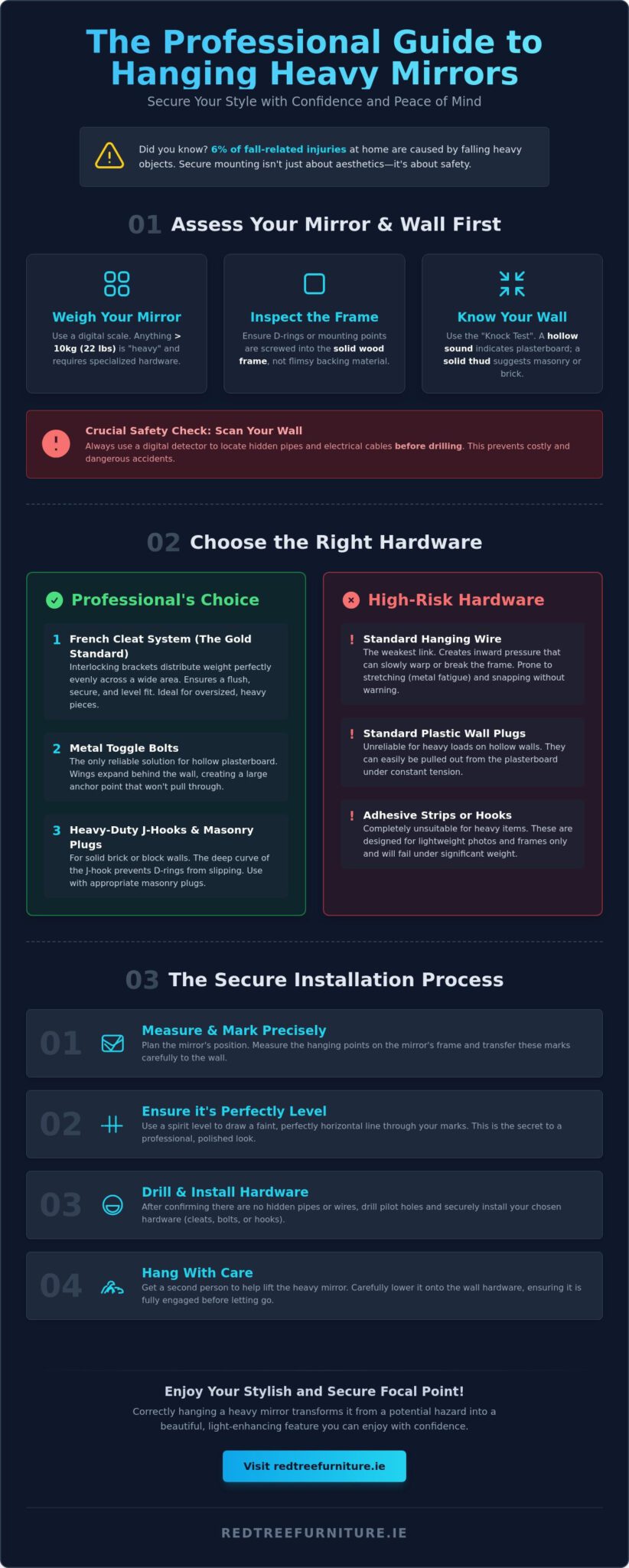
Did you know that 6% of fall-related injuries at home are actually caused by the fall of heavy objects? When you’ve invested in a stunning, oversized statement mirror to brighten your living space, the last thing you want is for it to become a safety hazard. Learning how to hang a heavy mirror safely is the essential bridge between a beautiful design choice and a secure, comfortable home. It’s natural to feel a bit of anxiety about the weight of the glass or the strength of your drywall, especially with recent safety recalls on certain wall mirrors highlighting the vital importance of secure mounting.
We believe your home should be a sanctuary where style meets substance. You likely want your new mirror to act as a light-filled focal point without the constant worry of it shifting or falling. This guide will provide you with the professional techniques needed to secure even the most substantial pieces to any wall type, from brick to plaster. We’ll explore the best hardware options for 2026, including French cleats and heavy-duty anchors, so you can enjoy your home’s aesthetic with complete peace of mind and quiet confidence.
Key Takeaways
- Learn why weighing your mirror with a digital scale is the essential first step to choosing the correct support for masonry or plasterboard walls.
- Discover the professional secrets of how to hang a heavy mirror safely using high-performance hardware like French cleats for even weight distribution.
- Master the precision of a spirit level to ensure your statement mirror sits perfectly level, creating a polished and professional look in any room.
- Avoid common safety pitfalls by understanding why adhesive strips aren’t suitable for heavy pieces and how to protect hardware in high-moisture areas.
- Find out how to position your mirror to enhance natural light and create a harmonious flow with your dining table or sideboard.
Assessing Your Mirror and Wall Type: The First Step to Safety
Before you pick up a drill, you need to know exactly what you’re working with. Guessing the weight of a large mirror is a recipe for disaster. Stand on your bathroom scale while holding the mirror, then subtract your own weight to get a precise reading. This number dictates every decision you make next, from the anchors you buy to the tools you’ll need. You should also inspect the back of the frame. Check if the existing D-rings are screwed into solid wood or just thin backing material, as a heavy mirror requires a frame that can actually support its own weight. Learning how to hang a heavy mirror safely starts with these structural basics.
The “Knock Test” and Identifying Wall Substrates
Knowing your wall material is just as vital as knowing the mirror’s weight. Give the wall a firm tap with your knuckles. A hollow, echoing sound indicates plasterboard or a stud partition, while a dull, solid thud suggests masonry or brick. In many modern Irish homes, you’ll encounter a “dot and dab” finish. This is where plasterboard is attached to solid blocks with dabs of adhesive, leaving a small, hollow gap between the two. It’s a deceptive surface because it sounds hollow but has a solid heart. To secure a heavy piece here, your fixings must bridge that gap and bite deep into the masonry behind it. Always use a digital detector to check for hidden pipes and cables before you begin. Hitting a water pipe or an electrical line will turn a simple home improvement project into an expensive emergency.
Weight Capacity and Structural Integrity
In the world of interior design, we generally define any mirror over 10kg as “heavy.” For these substantial pieces, standard hanging wire often isn’t enough, as it can stretch or snap over time under constant tension. Instead, look for robust D-rings or consider a French cleat system, which distributes the weight across a wide horizontal area of the wall. This method is particularly effective for mirrors that act as focal points above sideboards or console tables. You must ensure the frame itself is sturdy; a heavy glass pane in a weak, glued frame can eventually pull the frame apart if not supported correctly. Standard plastic wall plugs generally shouldn’t be trusted for weights exceeding 10kg on hollow walls without being anchored directly into timber studs. By identifying the timber studs with a reliable stud finder, you create a “sweet spot” for your screws that offers maximum security and peace of mind.
Selecting the Correct Hardware for Heavy Mirrors
Choosing the right hardware isn’t just a matter of utility; it’s about protecting your investment and your family. The hardware you select serves as the invisible foundation for your home’s aesthetic. When you’re researching how to hang a heavy mirror safely, you’ll find that professional-grade solutions far outperform the basic hooks found in a standard toolkit. For those truly grand, oversized pieces that define a room, a French cleat system is the gold standard. This system uses two interlocking brackets, one on the wall and one on the mirror, to distribute weight evenly across a wide horizontal plane. It ensures the mirror remains perfectly level and flush against the wall, providing a sleek, gallery-like finish.
If your mirror arrives with pre-installed D-rings and you’re mounting into masonry, heavy-duty J-hooks are a reliable alternative. These hooks feature a deep, curved seat that prevents the rings from slipping. However, if you’re working with hollow plasterboard, you’ll need to look beyond standard screws. Metal toggle bolts are often the only reliable solution here. They function by expanding behind the wall board, creating a broad surface area of support that resists being pulled through the material. For the best results, always pair these with strap hangers. Unlike traditional loops, strap hangers are long, flat metal plates that screw into multiple points on the mirror frame, offering superior stability for heavy loads.
Why Hanging Wire is a Safety Risk
Many homeowners default to traditional braided wire, but for heavy mirrors, this is often the weakest link. Wire creates significant inward pressure on the vertical sides of the frame. Over time, this constant tension can actually cause the frame joints to pull apart or collapse. There’s also the persistent risk of metal fatigue or “wire creep.” This is where the metal slowly stretches under the weight until it eventually snaps without warning. To maintain the integrity of your piece, we recommend avoiding wire altogether for items over 10kg. Using two direct points of contact between the frame and the wall hardware is a much more secure approach that eliminates these structural stresses.
The Science of Wall Anchors
Understanding the shear strength of your fixings is what separates a DIY job from a professional installation. Plastic expansion plugs are suitable for light décor, but they lack the grip required for substantial weight on hollow walls. Metal toggle anchors or high-load fixings, such as GripIt, are engineered to handle significant weight by spreading the load across the back of the plasterboard. Research shows that heavy-duty kits are often rated for 100 to 200 lbs, providing a massive safety margin for most domestic mirrors. For solid brick or concrete, look for sleeve anchors or masonry bolts that bite directly into the substrate. Selecting the right hardware ensures your wall mirrors remain a safe, stylish, and permanent fixture in your home.
A Step-by-Step Guide to Secure Installation
Once you’ve selected your professional-grade hardware, it’s time to bring your design vision to life. Precision is your best friend during this stage, as even a minor miscalculation can lead to a crooked finish or unnecessary holes in your plaster. Mastering the physical process of how to hang a heavy mirror safely requires patience and a logical sequence of movements. By taking a methodical approach, you ensure that your mirror becomes a permanent, secure foundation for your room’s aesthetic rather than a safety concern.
Measuring Twice and Marking Once
Avoid the temptation to hold a heavy mirror against the wall while trying to mark your points. Instead, use painter’s tape to outline the mirror’s exact footprint on the wall surface. This tactile approach lets you visualize the scale and height without any physical strain. For the most accurate results, create a paper template by laying the mirror face down on a sheet of brown paper and tracing its outline. Mark the exact position of the hanging hardware on this template, then tape the paper to your wall. This method allows you to use a spirit level to ensure a perfectly horizontal line before you ever touch a drill. Remember the “two-person rule” for this stage; having a partner to help steady the template or the mirror itself is essential for both safety and accuracy.
Drilling and Anchoring Techniques
Your choice of drill bit must match the wall substrate you identified earlier. Use a sharp masonry bit for brick or block, or a standard wood bit if you’re drilling directly into timber studs. When you’re ready to drill, maintain a steady hand and apply consistent pressure to create a clean, straight pilot hole. To ensure the maximum possible grip for your wall anchors, always clear any remaining masonry dust from the pilot hole using a vacuum or a small hand pump. Once the hole is clear, tap your anchors into place until they sit completely flush with the wall surface. Avoid over-tightening the screws, as this can strip the anchor’s internal thread and compromise the structural integrity of the fix. The goal is a firm, solid connection that feels rooted in the wall.
With the brackets or hooks securely in place, it’s time for the final installation. Lift the mirror with your partner, keeping your backs straight and using your legs for power. Gently lower the frame onto the hardware, feeling for the moment the brackets interlock or the D-rings settle into the hooks. Don’t let go immediately. Keep a light grip on the frame while your partner verifies that the mirror is stable and level. Once you’re confident in the connection, step back and admire how the light interacts with the glass, knowing your beautiful statement piece is anchored with professional-grade security.
Avoiding Common Mistakes and Long-Term Safety
Once your mirror is securely mounted, the goal is for it to remain a permanent, beautiful part of your home for years to come. Many homeowners assume the job is done once the level is straight, but long-term safety requires a bit of ongoing attention and an understanding of your home’s environment. Gravity never takes a day off. Learning how to hang a heavy mirror safely means acknowledging that even the most secure installation can be affected by external factors like moisture, vibration, and temperature changes over time.
The Myth of Adhesive Strips for Heavy Loads
It’s incredibly tempting to reach for “no-drill” adhesive strips, especially if you’re renting or simply want to avoid making holes in your walls. For heavy glass and substantial frames, this is a dangerous gamble that rarely pays off. Adhesive bonds rely on chemical tension that can degrade without warning, particularly when subjected to the constant “dead load” of a heavy mirror. Temperature fluctuations in Irish homes can cause these chemical bonds to become brittle or tacky, leading to a sudden failure. When you’ve invested in Contemporary Dining Furniture Ireland, protecting your high-end decor from falling objects is a priority. Mechanical fixings are the only reliable way to ensure your statement piece remains a secure fixture in your sanctuary.
Placement for Maximum Security
Where you choose to position your mirror is just as vital as the hardware you use. Avoid “clash zones,” such as the space directly behind a door or in a very narrow hallway where a passing shoulder might catch the edge of the frame. In high-traffic areas, vibration is a subtle but real factor. Over months, the movement of people walking by can cause a mirror to shift or rattle. To counter this, consider anchoring the bottom of the frame with small, discreet brackets or use heavy-duty rubber bumpers. These bumpers also protect your wall from unsightly scuffs and allow for a small amount of vital airflow behind the frame, which is particularly important for preventing moisture build-up.
If you’re hanging a mirror in a bathroom, remember that steam is the enemy of standard hardware. Constant humidity can lead to rust on non-treated screws and brackets, eventually weakening the entire installation. Ensure your bathroom has adequate ventilation and always choose stainless steel or rust-proof hardware to maintain structural integrity. Finally, make it a habit to perform a quick safety check every few months. Look for tiny cracks in the plaster around your anchors or any slight tilting of the frame. Catching these early signs of strain is the final step in mastering how to hang a heavy mirror safely. If you’re looking to add a new focal point to your room, browse our collection of Wall Mirrors to find a piece that perfectly balances style and substance.
Elevating Your Space with Statement Wall Mirrors
A statement mirror is far more than just a reflective surface. It’s a sophisticated design tool that manipulates light and perception to transform the atmosphere of a room. In many Irish homes, where natural light can be precious during the winter months, a large mirror acts as an additional window. By positioning it strategically opposite a light source, you amplify the brightness of the space and create a welcoming, airy feel. This transformation is exactly why learning how to hang a heavy mirror safely is such a rewarding skill. It gives you the freedom to introduce substantial, high-end pieces that serve as the anchor for your entire interior scheme.
Design Strategies for Large Mirrors
Think of a large mirror as a way to “double” the size of your environment. In a compact dining room, a mirror placed at eye level can make the area feel twice as expansive, adding a sense of luxury and breathing room. To maintain a sense of balance, many designers follow the “Rule of Thirds.” When you’re positioning a mirror above a console table or a fireplace, the mirror should ideally occupy about two-thirds of the width of the furniture below it. This ensures the piece feels grounded rather than floating. Pairing your mirror with a well-placed lamp or a set of wall sconces adds a sophisticated evening glow, as the glass catches and scatters the light across the textures of your textiles and furniture.
Why Quality Matters in Mirror Construction
Your choice of mirror should reflect your pride in your home. There’s a significant difference between mass-produced, thin glass and premium wall mirrors designed for longevity. High-quality mirrors feature thicker glass and reinforced frames that resist warping and provide a much clearer reflection. At Red Tree Furniture, we carefully select mirrors that combine high-fashion design terminology with the structural durability required for a permanent home fixture. We believe that a mirror should be as sturdy as it is beautiful, ensuring it remains a safe focal point for family connection for years to come.
Your mirror shouldn’t exist in isolation; it should speak to the other elements in your room. If you’ve recently invested in a new dining table, a sleek, modern mirror can maintain that clean aesthetic and tie the room together. Mirrors also serve as the perfect companion to sideboards, where they create a layered look that feels curated and intentional. Once you’ve mastered the techniques for how to hang a heavy mirror safely, you can invest in these statement pieces with total confidence in their security and style. Ready to transform your home with a stunning new focal point? Explore our curated collection of Wall Mirrors to find the perfect match for your space.
Transform Your Home with Confidence
Securing a stunning focal point shouldn’t be a source of stress. By accurately weighing your piece and identifying your specific wall substrate, you’ve already laid the groundwork for a secure installation. Whether you choose the robust support of a French cleat system or the reliability of metal toggle bolts, mastering how to hang a heavy mirror safely ensures your home remains both beautiful and protected. Regular safety checks and smart moisture management are the final steps to maintaining that gallery-style finish for years to come.
At Red Tree Furniture, we combine high-fashion design with the practical durability your home deserves. As a family-owned business with Irish expertise since 2007, we take pride in helping you create spaces that reflect your unique style. We offer nationwide delivery on all our statement pieces, making it easier than ever to find a mirror that perfectly complements your dining table or sideboard. Browse our designer wall mirrors at Red Tree Furniture and find the next foundation for your stylish life. Your home is a sanctuary. Enjoy every light-filled moment with total peace of mind.
Frequently Asked Questions
Can I hang a heavy mirror on a plasterboard wall without a stud?
Yes, you can secure a mirror to plasterboard without a stud by using high-load metal toggle anchors or specialized fixings like GripIt. These anchors are engineered to expand behind the board, spreading the weight across a larger surface area to prevent the mirror from pulling through. While these modern fixings are incredibly strong, anchoring directly into a timber stud remains the most secure method for exceptionally heavy statement pieces.
How much weight can a French cleat actually hold?
A heavy-duty French cleat system is typically rated to support between 45kg and 90kg, depending on the length of the bracket and the wall type. Because the interlocking design distributes the load evenly across a wide horizontal plane, it’s the most reliable choice for oversized mirrors. Always verify the specific weight rating on your hardware’s packaging to ensure it exceeds the weight of your mirror for a safe installation.
What is the best height to hang a large wall mirror?
The ideal height for a large mirror is generally eye level, with the centre of the glass sitting approximately 145cm to 152cm from the floor. If you’re positioning the mirror above a sideboard or console table, aim for a gap of 15cm to 20cm between the bottom of the frame and the furniture surface. This placement ensures the mirror feels like an intentional part of your room’s design rather than a disconnected object.
Is it safe to use a wire to hang a heavy mirror?
No, using a traditional braided wire is often unsafe for mirrors weighing over 10kg because it creates significant inward stress on the frame’s vertical joints. This tension can cause the frame to warp or pull apart over time, and metal fatigue may lead to the wire snapping without warning. For the best results, use two direct points of contact between the frame hardware and the wall hooks to distribute the weight vertically.
How do I know if my wall is made of brick or plasterboard?
You can identify your wall material by performing a “knock test” with your knuckles to listen for a hollow or solid sound. Plasterboard or stud partitions will produce a clear, echoing ring, while masonry or brick walls result in a dull, heavy thud. If you’re still unsure, drill a tiny pilot hole in a discreet area; white dust indicates plasterboard, while red or grey dust confirms you’re working with brick or concrete blocks.
Do I need a professional to hang my heavy mirror?
While many homeowners can complete the job with a partner and the right tools, hiring a professional is a wise choice for exceptionally valuable or fragile pieces. A professional installer understands the nuances of how to hang a heavy mirror safely on complex surfaces like “dot and dab” walls. If the mirror requires specialist masonry drilling or you’re uncomfortable handling the weight, the investment in a pro offers invaluable peace of mind.
What should I do if my mirror frame starts to pull away from the wall?
Take the mirror down immediately if you notice the frame shifting or a gap appearing between the wall and the hardware. This movement is a clear sign that the anchors are failing or the wall substrate is beginning to crumble under the weight. You’ll need to patch the area and move your mounting points, perhaps upgrading to a French cleat system that anchors into multiple points for improved structural security.
How do I prevent a mirror from leaning forward too much?
To keep a mirror flush against the wall, ensure your hanging hardware is mounted as close to the top of the frame as possible. If you’re using hooks and D-rings, the higher the rings are placed, the less the mirror will tilt forward. You can also place small rubber bumpers or adhesive foam pads on the bottom corners of the frame. These pads act as spacers that keep the mirror level and prevent it from swinging.