
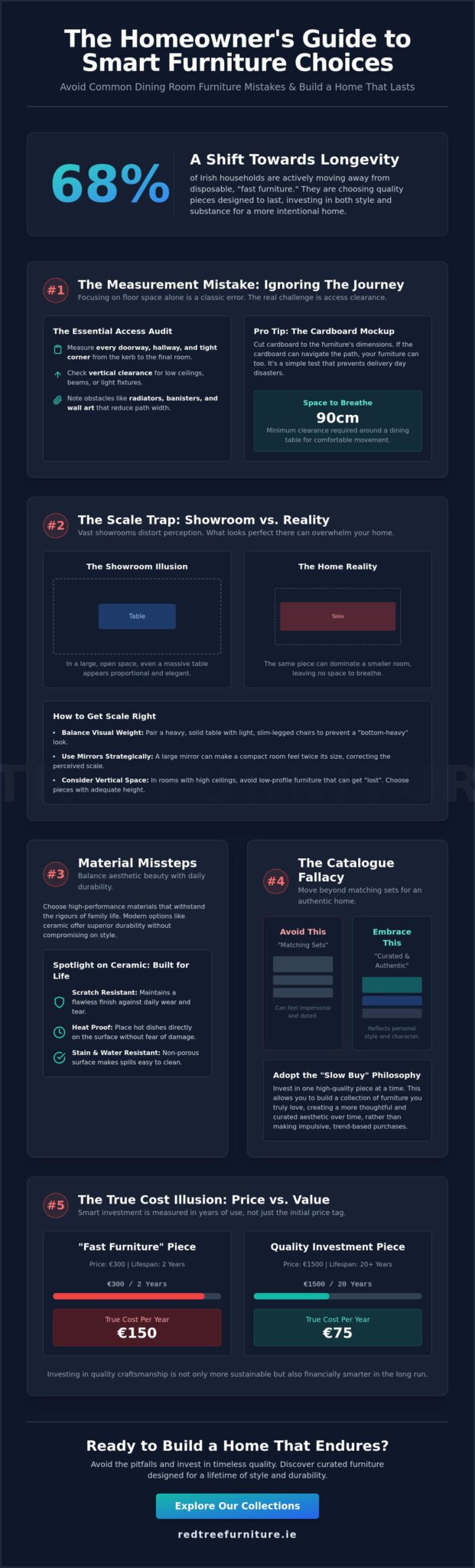
Did you know that 68% of Irish households are now actively moving away from disposable furniture in favour of pieces that offer genuine longevity? It’s a significant shift in how we view our homes, yet many homeowners still find themselves trapped by common dining room furniture mistakes that lead to post-purchase regret. Perhaps it’s a table that looked perfect in the showroom but leaves no room to breathe in your actual space, or a material that hasn’t stood up to the rigours of family life. Choosing the wrong scale or a high-maintenance finish can quickly turn a dream interior into a source of daily frustration.
We understand that selecting the right pieces is about more than just filling a room; it’s about creating a sanctuary where style and substance coexist. You want a home that feels curated and intentional, not cluttered or dated. In this guide, you’ll learn how to navigate the technical and aesthetic pitfalls of furniture shopping to create a space that balances contemporary Irish charm with lifelong durability. We’ll explore why materials like ceramic are becoming a staple for the modern home, how to master the “warm minimalism” trend, and the secrets to ensuring your new sideboard or dining suite arrives exactly as you imagined.
Key Takeaways
- Learn how to measure for access clearance rather than just floor space to avoid the heartbreak of furniture that won’t fit through the door.
- Discover how to judge scale and proportion accurately so your new pieces complement your room instead of overwhelming it.
- Avoid common dining room furniture mistakes by choosing durable, high-performance materials like ceramic that stand up to the rigours of Irish family life.
- Understand the “Slow Buy” philosophy and why moving away from matching sets creates a more authentic, curated home aesthetic.
- Calculate the true cost-per-year of your furniture to see why investing in quality craftsmanship is a smarter choice than “fast furniture” alternatives.
The Doorway Dilemma: Measuring for More Than Just Floor Space
One of the most disheartening experiences for any homeowner is watching a beautiful new sideboard or table arrive at the front door, only to realise it won’t actually fit inside. It’s a classic example of dining room furniture mistakes that occur long before the first dinner party. While we often obsess over whether a piece fits the aesthetic of our room, we frequently overlook the physical journey it must take from the delivery van to its final destination. Measuring for floor space is only half the battle; you must also measure for the journey.
There’s a critical technical difference between floor space and access clearance. Floor space is the footprint the furniture occupies once it’s settled. Access clearance, however, accounts for the “turn radius” and diagonal depth required to move a solid object through a three-dimensional path. In many traditional Irish homes, narrow hallways and sharp turns at the base of stairs can make even a standard-sized console table a logistical challenge. You need to map out a clear delivery path from the kerbside, through the porch, and into the final room, noting any architectural bottlenecks along the way.
Don’t forget to look up. Tall TV units or shelving can be sabotaged by low ceiling beams or ornate light fixtures. If you’re planning for a grand statement piece, ensure your delivery path and final placement area have the vertical clearance to accommodate the height without grazing your favourite pendant lamp. It’s these small details that determine whether delivery day is a triumph or a headache.
Step-by-Step: The Essential Access Audit
Start at the kerbside and work your way in. Measure the narrowest point of your front door frame and every internal doorway. Don’t just measure the floor; account for protruding radiators, low banisters, and wall-mounted art that might be in the line of fire. A brilliant trick is the Cardboard Mockup. Cut a piece of cardboard to the exact dimensions of your new table or sideboard. Move it through your home to see exactly where the tight spots are. It’s much easier to pivot a piece of cardboard than a heavy ceramic dining table.
Planning for the Final Placement
Once the piece is inside, it needs room to breathe. Proper principles of interior design suggest maintaining a minimum of 90cm clearance around dining tables. This space is essential for guests to pull out chairs and move comfortably without hitting walls or other furniture. Avoiding the clutter trap means leaving enough distance between disparate pieces so the room feels intentional rather than cramped. Breathable space is just as important as the furniture itself; it allows the beauty of your chosen materials, like smooth wood or polished stone, to truly stand out. This planning helps you avoid common dining room furniture mistakes that lead to a room feeling overcrowded and uninviting.
The Scale Trap: Why Showroom Elegance Can Fail at Home
Walking through a vast furniture warehouse can be deceptive. A massive ceramic dining table that looks perfectly proportional in a 500sqm showroom often transforms into an overwhelming behemoth once it’s placed in a standard Irish dining room. This disconnect is at the heart of many dining room furniture mistakes. To avoid this, it’s vital to distinguish between scale and proportion. Scale refers to how an object relates to the size of the room itself, while proportion is about how it relates to the other objects surrounding it.
If you’re dealing with a compact space, you don’t necessarily have to settle for tiny furniture. Instead, use strategic design elements like wall mirrors to correct the perceived scale. A well-placed mirror reflects light and depth, making the room feel twice its actual size and allowing a larger table to feel right at home. Conversely, if you have high ceilings, be wary of low-profile coffee tables. Without enough vertical presence, these pieces can get “lost” in the volume of the room, making the space feel unfinished and cold.
Balancing Your Room’s Visual Weight
Achieving a cohesive look is all about managing visual weight. If you’ve chosen a heavy, statement material like marble for your table, consider pairing it with lighter, slim-legged dining chairs. This prevents the room from feeling “bottom-heavy.” Sideboards are excellent for anchoring a large wall; they provide functional storage and a visual focal point without eating into the central floor plan. For a truly curated feel, apply the rule of thirds. Vary the heights of your furniture and decor to keep the eye moving and ensure the room feels balanced rather than flat.
Choosing the Right Shape for Your Layout
The shape of your furniture significantly impacts the social flow of your home. A round dining table is often superior to a rectangular one in smaller square rooms because it eliminates sharp corners that disrupt movement. Choosing a pedestal base over a traditional four-leg design can also make a table feel lighter and less intrusive. When selecting contemporary dining furniture Ireland, look for clean lines and organic silhouettes that complement your home’s architecture. If you’re unsure how a piece will fit, our team at Red Tree Furniture can help you visualise how different shapes interact with your specific layout. You might find that a sleek set of chairs is exactly what’s needed to balance a robust table and avoid common dining room furniture mistakes.
Material Missteps: Balancing Aesthetic Beauty with Daily Durability
Investing in your home is a long-term commitment. One of the most frequent dining room furniture mistakes is prioritising the initial price tag over the “cost-per-year” value. A bargain table that requires replacement after just three years is far more expensive than a quality piece that lasts a decade. While traditional wood has long been a staple in Irish homes, our modern lifestyles demand something more resilient. Today, the dining table is often a multi-functional hub for remote work, school projects, and family meals, making material choice more critical than ever.
Comparing surfaces is essential for long-term satisfaction. Glass tables offer a sleek, airy aesthetic that works beautifully in smaller rooms, yet they require frequent polishing to manage fingerprints and smudges. Marble is undeniably luxurious, but its porous nature means it can be easily damaged by acidic spills or red wine if not sealed regularly. This is why the “touch test” in a showroom is so vital. You need to feel the weight of the piece and the texture of the grain to truly assess its integrity. Physical interaction helps you distinguish between a surface that’s merely beautiful and one that is built to endure.
The Case for Ceramic Dining Tables
Ceramic has quickly become a leading choice for the contemporary home. It offers a unique trifecta of family-friendly benefits: it is heat, scratch, and stain resistant. Unlike natural stone, it doesn’t require specialist sealing or delicate handling. These ceramic dining tables Ireland are designed to mimic the sophisticated patterns of marble or slate while providing a surface that is virtually indestructible. It’s the ultimate marriage of high-fashion design and practical, domestic benefit.
Selecting Upholstery for Longevity
When choosing dining chairs or bar stools, look beyond the colour. Check the Martindale rub count, which measures a fabric’s durability; for a busy household, you should aim for a score of 20,000 or higher. Velvet provides a rich, tactile experience and a sense of quiet luxury, while high-quality faux leather offers a practical, wipe-clean surface for homes with young children or pets. Regardless of the textile, the frame construction is what dictates the lifespan of your seating. Ensure the legs and joints feel sturdy and well-balanced to avoid the wobbles that often plague lower-quality alternatives.
The Catalogue Fallacy: Avoiding Matching Sets and Impulsive Trend-Chasing
There is a tempting convenience in purchasing an entire furniture collection from a single page of a brochure. However, doing so is one of the most common dining room furniture mistakes, often resulting in a space that feels more like a sterile hotel lobby than a lived-in home. This “catalogue fallacy” strips a room of its character and soul. Instead, we advocate for the Slow Buy philosophy. This approach involves selecting pieces over time, allowing your home to evolve and reflect your personal journey rather than a single moment in a retail cycle.
To succeed with this method, your dining table should serve as the definitive anchor. Once you have this central hero piece, you can build around it with contrasting textures and styles. Distinguishing between a passing trend and a modern classic is key. While earth-toned palettes and organic silhouettes are currently leading Irish design for 2026, they endure because they tap into our innate desire for comfort and nature. Avoid impulsive purchases of “fast furniture” that lack the craftsmanship to survive the next style shift.
The Art of Mixing Materials
Creating sensory depth is what makes a room feel curated. Try pairing the cool, smooth surface of a marble table with the warmth of textured fabric dining chairs. This contrast creates a sophisticated visual tension that matching sets simply cannot achieve. If you’re mixing different wood finishes, follow the undertone rule: keep your woods within the same temperature, such as pairing warm oaks with walnut. A sculptural sideboard can also act as a standalone statement, breaking up the uniformity of a room while providing vital storage.
Defining Your Personal Style Anchor
Every successful room has one clear hero piece that draws the eye. If your table is the star, keep your foundation pieces neutral to allow it to shine. You can then use trend-led accessories like wall mirrors or lamps to refresh the look without a total overhaul. Remember that lighting plays a massive role in how furniture finishes appear; a warm ochre fabric might look vastly different under cool LED bulbs versus soft evening light. To find the perfect balance for your home, browse our curated collections and discover how individual pieces can come together to tell your unique story.
Red Tree Furniture: Guiding Your Journey Toward a Curated Home
At Red Tree Furniture, we believe that your home is the foundation for a stylish and comfortable life. We don’t just curate collections; we vet every material to ensure it stands up to the specific demands of the Irish market. Whether it’s for a bustling family kitchen or a sleek contemporary apartment, we understand that furniture must be as resilient as it is beautiful to meet the varied demands of Irish homes. Our commitment to the “Style meets Substance” philosophy means we’ve already done the hard work of testing durability, so you don’t have to worry about the common dining room furniture mistakes that lead to premature wear or buyer’s regret.
Visiting our showroom offers a tactile experience that a digital screen simply cannot replicate. It’s the best way to truly visualise scale and texture, allowing you to run your hand over a smooth ceramic surface or test the sturdiness of a dining chair frame. As a family-owned business, we value the legacy of your home. We aren’t just selling objects; we’re helping you select the focal points where your family will connect for years to come. Our deep understanding of domestic life across the country gives us a unique perspective on what Irish homeowners truly need, from space-saving solutions to grand statement pieces.
Our background in both trade and retail ensures that every step of your journey is handled with professional polish. We understand the logistics of Irish housing, from narrow doorways to the technical requirements of a safe, seamless delivery. This expertise allows us to guide you through the practicalities of technical specifications, ensuring that the piece you fall in love with in the showroom fits perfectly in your environment.
Design-Led Solutions for Every Room
Creating a cohesive home involves more than just the dining suite. We offer design-led solutions that create a natural flow throughout your living spaces. From sculptural coffee tables that anchor your lounge to elegant console tables for your entryway, our collections are designed to work in harmony. Our ceramic and marble ranges remain the cornerstone of contemporary living, offering the accessible luxury and ease of maintenance that modern households demand. Our expert team is always on hand to provide the knowledgeable advice you need to avoid dining room furniture mistakes and build a space that feels uniquely yours.
Start Your Transformation Today
You can invite the Red Tree aesthetic into your home with absolute confidence, knowing that each piece has been chosen for its longevity and fashion-forward design. We invite you to explore our world of textures, materials, and silhouettes. Browse our curated collections online to find your next hero piece, or visit our showroom to experience the quality and craftsmanship firsthand. It’s time to move away from disposable furniture and invest in a home that reflects your style and stands the test of time.
Explore our latest Contemporary Dining Collections
Elevate Your Home with Confidence and Style
Building a home that reflects your personality while meeting the demands of daily life is a rewarding journey. By mastering the technicalities of access clearance and the nuances of visual scale, you’ll easily avoid the most frequent dining room furniture mistakes that lead to cluttered or impractical spaces. The most beautiful interiors are built with intention, prioritising high-performance materials like ceramic and marble over fleeting, disposable trends that don’t stand the test of time.
Since 2007, Red Tree Furniture has operated as a family-owned Irish business dedicated to helping you find that perfect balance between style and substance. Our expertise in contemporary design, paired with our national delivery service and expert showroom guidance, ensures that your vision for a curated home becomes a reality. Whether you’re looking for a statement dining suite or a sculptural sideboard, we’re here to guide you toward pieces that offer both elegance and lifelong durability.
Discover Contemporary Dining & Living Furniture at Red Tree Furniture
Now is the time to transform your living space into a sanctuary of comfort and sophisticated design that your family will enjoy for years to come.
Frequently Asked Questions
What is the most common mistake people make when buying a dining table?
Choosing the wrong size relative to the room’s footprint is the most frequent error. Many homeowners don’t account for the space needed to pull out chairs or walk behind seated guests. This leads to a cramped environment that’s difficult to navigate. Always prioritise a table that leaves enough breathable space to ensure your dining area feels intentional and comfortable rather than overcrowded.
How do I know if a large table will fit through my front door?
You must measure the narrowest point of your entry path, including the door frame and any sharp hallway turns. Compare these dimensions to the table’s narrowest point, which is usually its depth or height if the legs are removable. Don’t forget to check the diagonal clearance; navigating tight Irish hallways often requires more room than a simple width measurement suggests.
Is it better to buy a matching furniture set or mix and match pieces?
Mixing and matching pieces is generally superior for creating a home that feels curated and authentic. While matching sets are convenient, they often lack the character and sensory depth of a carefully selected room. Pairing a sleek ceramic table with textured fabric chairs creates a sophisticated visual contrast that makes your space feel like a personal sanctuary rather than a sterile hotel lobby.
Why does furniture often look different in my home than in the showroom?
Showrooms use professional-grade lighting and high ceilings that can dramatically alter your perception of scale and colour. A large sideboard might look modest in a 500sqm warehouse but feel much more imposing in a standard domestic dining room. Additionally, the warm or cool tones of your home’s lighting will change how a wood grain or fabric finish appears compared to the showroom floor.
What are the most durable materials for a family dining table in 2026?
Ceramic has emerged as the leading choice for durability in 2026 because it’s virtually scratch, heat, and stain resistant. It’s a perfect fit for the multi-functional Irish home where the table serves as a workspace and a dining hub. High-quality tempered glass and properly sealed marble are also excellent options, providing a luxurious aesthetic without the high-maintenance requirements of traditional softwoods.
How much space should I leave between my dining table and the wall?
Aim for a minimum of 90cm of clearance between the table edge and the wall or any other furniture. This distance is essential for allowing guests to pull out their chairs and move around the room without bumping into obstacles. If you have the luxury of a larger floor plan, extending this to 100cm or 120cm will create a more relaxed and airy atmosphere.
Should I buy all my furniture at once or wait?
Adopting a “Slow Buy” philosophy is usually the best way to avoid expensive dining room furniture mistakes. By starting with a hero piece, like a central dining table, you can live in the space and see how it functions before committing to secondary items. This gradual approach ensures that every sideboard or console table you add serves a genuine purpose and fits your evolving style.
How can I tell if a piece of furniture is high quality just by looking at it?
Inspect the joinery and the overall weight of the piece to gauge its craftsmanship. High-quality furniture features sturdy, well-aligned joints and a consistent finish across all surfaces, including the parts that aren’t immediately visible. Quality materials like stone, ceramic, or solid wood have a natural heft and a tactile richness that “fast furniture” alternatives simply cannot replicate during a physical showroom test.