
Imagine hosting a dinner party where a spilled glass of red wine doesn’t result in a ruined heirloom. While many homeowners believe that true luxury requires high-maintenance materials, the most sophisticated choice for a modern home is often the most resilient. Choosing a ceramic dining table that looks like marble allows you to capture that timeless elegance without the constant anxiety of staining, etching, or scratching.
It’s natural to feel protective of your furniture, especially in a busy kitchen where life happens quickly. You want a stunning focal point that invites guests in, not a delicate surface that makes you nervous. This guide will show you how to achieve the prestigious look of natural stone with the unmatched durability of contemporary ceramic. We will explore the 2026 shift toward warmer tones and organic shapes, explain the technical differences between materials, and help you select a piece that remains beautiful for years with almost no effort.
Key Takeaways
- Understand why advanced ceramic is a technical evolution of natural stone, providing the same cool-to-the-touch finish without the porous vulnerability of traditional marble.
- Discover how a ceramic dining table that looks like marble supports a busy lifestyle by eliminating the need for periodic sealing or specialized stone polishes.
- Learn to choose between bold, sweeping veins and subtle patterns to ensure your table scale perfectly complements your room’s architecture.
- Get expert tips on pairing your table with the right dining chairs and statement lighting to create a balanced, sophisticated focal point.
- Explore how accessible luxury allows you to invest in high-end, design-led furniture that serves as a durable foundation for daily family life.
The Aesthetic of Marble Meets the Resilience of Ceramic
For generations, marble has been the gold standard for elegance. It’s the material of grand halls and historic estates. However, for a modern Irish family, the reality of living with natural stone often involves more stress than style. This is where the ceramic dining table that looks like marble comes in. It isn’t just a copy; it’s a high-tech fusion of natural minerals and advanced manufacturing that solves the practical problems of organic stone while retaining its prestigious visual appeal.
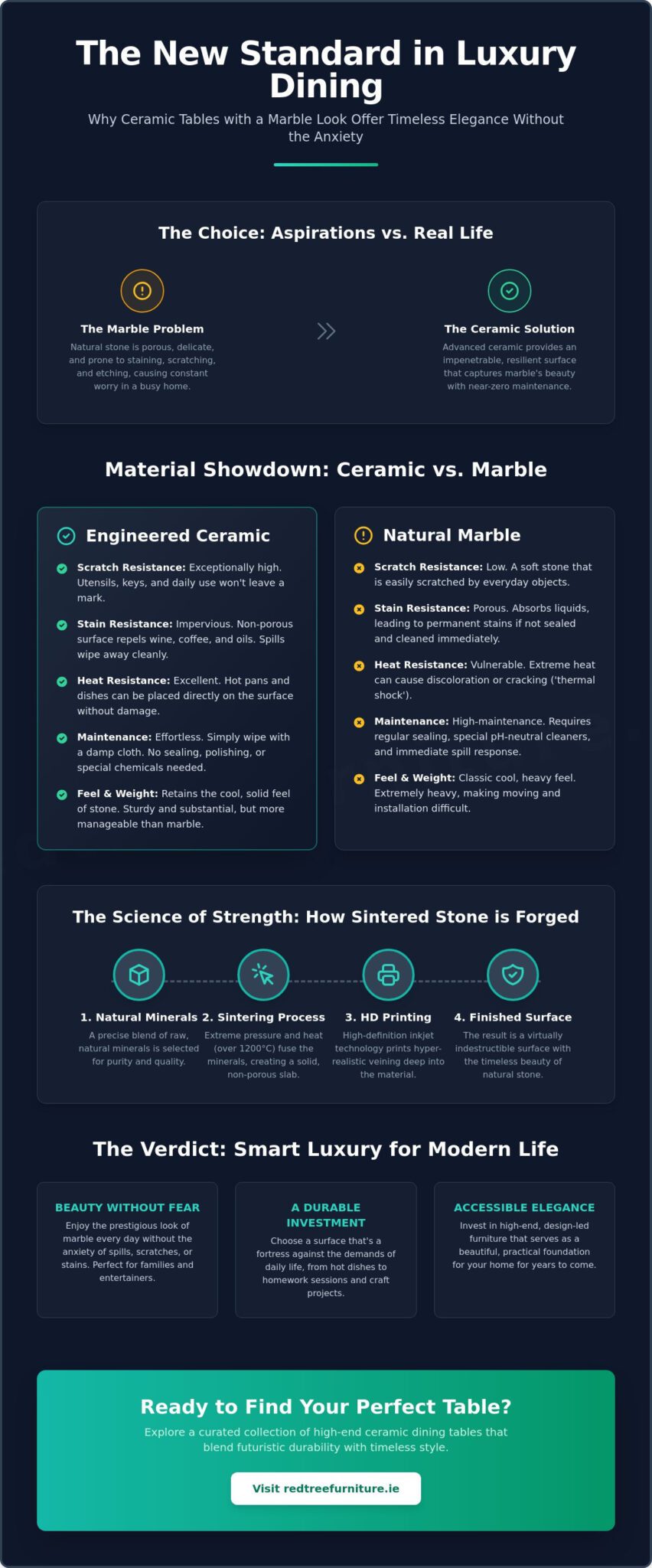
While natural marble is soft and porous, ceramic is engineered to be a fortress. It offers an impenetrable surface that resists the typical hazards of a busy home. This material represents a “smart luxury” choice. It allows you to enjoy the high-fashion aesthetic of a stone focal point without the constant worry about wine spills or heavy plates. It’s about bringing that aspirational lifestyle into a home that is actually lived in.
Why the Marble Look is a Timeless Interior Staple
Marble has graced architecture for millennia, from classical sculptures to the sleekest contemporary apartments. In 2026, it remains the pinnacle of interior sophistication because it brings a sense of permanence and prestige to a room. One of its most beautiful qualities is how it interacts with light. The polished or honed surface of a marble-effect top reflects natural light, making even a compact dining area feel airy and expansive. Whether you choose the crisp clarity of a white base or the moody depth of a grey pattern, the veining provides a natural artistry that complements everything from velvet chairs to industrial metal frames.
Ceramic Technology: How the “Marble” is Created
The secret to this material’s strength lies in its birth. Unlike natural marble, which is quarried from the earth with all its inherent flaws and pores, these slabs are engineered for perfection. Manufacturers use a process of sintering to subject raw minerals to extreme pressure and temperatures exceeding 1200 degrees Celsius. This mimics the way stone forms in nature but accelerates it to create a surface that is completely non-porous. To achieve the stunning visual depth, high-definition digital inkjet technology prints intricate, hyper-realistic veining deep into the material. It’s so precise that it’s difficult to distinguish from the real thing. Sintered stone represents the premium category of ceramic used in top-tier dining tables, offering a density and resilience that natural marble simply can’t match.
Choosing a ceramic dining table that looks like marble means you’re investing in a surface that is virtually impenetrable to the demands of daily life. This combination of ancient aesthetic and futuristic durability makes ceramic the definitive choice for those who refuse to compromise on either beauty or utility. You get the visual impact of a high-end gallery piece with a surface that can handle the heat of a Sunday roast or a heavy-handed homework session with ease.
Ceramic vs. Marble: Why Modern Homeowners are Switching
The most common question we hear in our showroom is whether a ceramic dining table that looks like marble actually feels like the real thing. It’s a fair concern. For many, the appeal of marble isn’t just the visual pattern, but the cold, smooth touch and the sheer weight of the piece. Modern ceramic production has mastered this tactile experience. Because ceramic is made from natural minerals, it retains that signature cool temperature and heavy, high-quality feel that defines a luxury dining space. It provides a durable artistic canvas for your home without the fragility of quarried stone.
Switching to ceramic is often a decision based on freedom. Real marble is notoriously heavy, making installation a logistical challenge and moving house a nightmare. Ceramic-topped tables are far more manageable while remaining incredibly sturdy. If you’re weighing up the pros and cons of different materials for your next investment, our Ceramic vs. Marble Tables: Which Is Best For You? guide offers a deeper look into these comparisons. It’s about finding that sweet spot where aspirational design meets the practicalities of a modern Irish home.
The Durability Factor: Scratch and Heat Resistance
In a busy household, the dining table is more than just a place to eat. It’s a workspace, a craft station, and a prep area. Ceramic excels here because of its position on the Mohs scale of mineral hardness. This scale measures how well a material resists being scratched. While marble is relatively soft and prone to marking, ceramic is exceptionally hard. You can place a hot pan directly from the oven onto the surface or accidentally slip with a steak knife without leaving a trace. This makes it the perfect foundation for families with young children or those who love to entertain frequently without the fear of damaging their investment.
Stain Resistance: The Red Wine Test
The biggest heartbreak for any marble owner is the staining caused by everyday liquids. Natural marble is porous, meaning it literally breathes and absorbs spills. A dropped lemon wedge or a splash of red wine can leave a permanent mark within minutes. Ceramic is entirely non-porous. It repels liquids rather than absorbing them. Common household acids like vinegar or citrus won’t dull the finish or cause discolouration. Daily care is refreshingly simple; a quick wipe with a damp cloth is all it takes to keep the surface looking brand new. You can browse our full range of ceramic dining tables to find a style that fits your lifestyle perfectly.
Choosing Your Perfect Marble-Effect Style and Pattern
Selecting a ceramic dining table that looks like marble is an exercise in personal expression. It isn’t just about picking a surface; it’s about finding the specific character of stone that resonates with your home’s architecture. While many people think of “marble” as a single look, the reality is a vast spectrum of artistic possibilities. You can choose a base that ranges from a crisp, snowy white to a deep, dramatic charcoal, each setting a completely different mood for your dining room.
Tactile experience is just as important as the visual. A high-gloss finish offers a formal, mirror-like quality that bounces light around the room, making it perfect for sophisticated evening dinner parties. On the other hand, a matt or satin finish feels more contemporary and organic. These softer finishes are increasingly popular in 2026 as they feel grounded and inviting. They also have the practical benefit of hiding fingerprints more effectively in a busy family kitchen, ensuring your ceramic dining table that looks like marble stays looking pristine with minimal effort.
Classic Carrara vs. Dramatic Calacatta Effects
Carrara-style ceramic is defined by its softer, grey-blue tones and delicate, feathered veining. It’s the ideal choice for a minimal, Scandi-inspired space where you want the table to feel like a quiet, elegant part of the room. In contrast, Calacatta-style ceramic features bolder, thicker veins with warmer gold or charcoal undertones. This is a statement-making look that demands attention, suiting more opulent or maximalist interiors where the table is the undisputed hero of the space.
The Impact of Table Shape on Pattern Flow
The silhouette of your furniture dictates how the pattern behaves. On a rectangular top, the veining creates a continuous landscape, allowing the eye to travel the length of the table in a smooth, linear motion. Circular ceramic tables often utilize a sunburst effect, where the patterns radiate from the centre to create a sense of movement and energy. If you’re deciding between these silhouettes, our guide on Round Dining Table Ideas for Modern Irish Homes provides excellent inspiration for creating intimate, conversation-friendly spaces.
When bringing your table home, consider the context of your existing finishes. If you have warm wooden floors, a Calacatta pattern with gold undertones will create a harmonious link between the materials. For a modern kitchen with sleek grey cabinetry, a cool-toned Carrara or a dramatic dark grey ceramic provides a sharp, professional finish. It’s these subtle matches that elevate a room from a collection of furniture to a curated home that feels both stylish and comfortable.
Styling Your Marble-Look Table for Maximum Impact
A ceramic dining table that looks like marble is more than a piece of furniture. It’s the anchor of your dining space. To truly let it shine, you need a supporting cast of textures and lighting that highlights its unique character. While the table provides the drama, the surrounding elements provide the comfort. Think of your dining room as a curated gallery where every piece works together to create a cohesive, inviting atmosphere.
Lighting is the most effective way to showcase the intricate veining of a ceramic top. A large statement pendant hung directly above the table creates a focused pool of light that draws the eye to the pattern. For high-gloss finishes, this light creates a beautiful shimmer. For matt surfaces, it reveals the subtle textures of the material. To balance the cool, hard surface of the stone, integrate soft textiles. A plush, woven rug under the table or heavy drapes can dampen acoustics and add a layer of domestic warmth that makes the space feel lived-in rather than just looked at.
Pairing with the Right Seating
Your choice of chairs can completely change the personality of your table. If you’ve chosen a crisp white marble-effect top, velvet dining chairs in deep jewel tones like emerald or sapphire provide a stunning, high-fashion contrast. For those who prefer a modern, industrial-chic aesthetic, pairing the table with black metal legs and cognac leather chairs creates a sophisticated edge. If you’re looking for more detailed advice, The Ultimate Guide to Choosing Dining Chairs offers a framework for finding the perfect match. For a more relaxed, communal atmosphere, integrating a dining bench on one side allows for flexible seating that feels less formal and more family-oriented.
Complementary Storage: Sideboards and Consoles
Since marble-effect ceramic often feels cool to the eye, adding a contemporary sideboard in a natural wood finish is a brilliant way to inject warmth into the room. The organic grain of wood acts as a perfect foil to the structured elegance of the stone. You can also use large wall mirrors to double the visual impact of the table’s veining by reflecting it throughout the space. Regarding the tabletop itself, adopt a “less is more” approach. A single sculptural vase or a simple bowl of fruit allows the natural artistry of the ceramic dining table that looks like marble to remain the undisputed hero of the room.
Ready to transform your dining space? You can browse our latest collection of dining furniture to find the perfect combination for your home.
Why Red Tree Furniture is the Destination for Ceramic Excellence
Choosing the right partner for your home investment is just as important as the material itself. At Red Tree Furniture, the O’Reilly family remains deeply committed to hand-selecting design-led pieces that reflect the nuances of modern Irish living. We believe in accessible luxury, which means bringing you high-fashion aesthetics and professional-grade durability without an exclusionary price tag. When you choose a ceramic dining table that looks like marble from our collection, you’re investing in a piece that has been vetted for both its artistic merit and its ability to withstand the daily rigours of a busy household.
Our service extends far beyond the showroom floor. We understand that large ceramic items require specialized handling, so we take immense pride in our reliable national delivery service. Our team ensures your new focal point arrives safely, whether you’re in a city centre apartment or a rural coastal village. We invite you to explore our wider range of ceramic dining tables Ireland to see how we blend contemporary trends with local reliability.
Quality Assurance and Craftsmanship
Quality isn’t just about the surface pattern; it’s about the engineering beneath. Our selection process for ceramic suppliers is rigorous, focusing on the density of the material and the precision of the inkjet veining. We also pay close attention to the structural integrity of the frames and bases that support our marble-effect tops. Whether it’s a sculptural pedestal or sleek metal legs, every component is chosen for its longevity. Our 2026 commitment is to maintain absolute integrity and quality in every single piece we offer for your home.
Expert Advice for Your Home
Scale and style queries can be tricky to navigate alone when you’re redesigning a room. Our knowledgeable team is always on hand to help, from matching veining patterns to selecting the right chair height for your space. We encourage you to reach out for a personalised consultation to ensure your ceramic dining table that looks like marble fits your lifestyle perfectly. We’re here to help you create a home that feels as good as it looks, providing the foundation for years of family connection.
Explore our Marble-Effect Ceramic Dining Collection and discover the perfect anchor for your dining room today.
Elevate Your Home with the Future of Dining
Bringing a ceramic dining table that looks like marble into your home is more than a design upgrade; it’s a commitment to a lifestyle of effortless elegance. You’ve learned that you don’t have to choose between the prestigious look of natural stone and the practical resilience needed for a busy family kitchen. By selecting the right veining pattern and pairing it with complementary textures like velvet or warm wood, you create a focal point that is both aspirational and deeply comfortable.
Since 2007, Red Tree Furniture has operated as a family-owned Irish business dedicated to expertly curated, design-led furniture. We take pride in offering accessible luxury with reliable national delivery to every corner of the country. Now that you’ve discovered the technical and aesthetic benefits of this revolutionary material, it’s time to find the piece that resonates with your personal style.
Browse our exclusive collection of marble-effect ceramic dining tables and take the first step toward a dining space that stays beautiful for years to come. Your perfect table is waiting to become the foundation for your next decade of family memories.
Frequently Asked Questions
Is a ceramic table that looks like marble as cold as real stone?
Yes, it feels remarkably similar to the real thing. Because it’s composed of natural minerals, it maintains that signature cool-to-the-touch sensation that many people love about stone. This tactile quality is part of what makes a ceramic dining table that looks like marble feel like a luxury investment rather than a synthetic alternative. It provides the sensory experience of stone without any of the high-maintenance drawbacks that usually come with organic slabs.
Will the marble pattern on a ceramic table fade over time?
No, the pattern is permanent. The marble effect is achieved through high-definition digital printing before the slab undergoes the sintering process at over 1200 degrees Celsius. This fuses the design into the material itself. Unlike cheaper laminates or veneers, these surfaces are UV stable and won’t yellow or fade, even when placed in direct sunlight. Your table will look just as vibrant and detailed a decade from now as it does today.
How do I remove a stain from a marble-effect ceramic dining table?
You’ll rarely need more than a damp cloth and a bit of mild dish soap. Since the surface is non-porous, liquids like red wine or coffee can’t penetrate the material. If you encounter a stubborn mark from a metal pot or a crayon, a non-abrasive cream cleaner usually does the trick. It’s much simpler than the specialized poultices and sealing treatments required for natural stone to stay looking pristine.
Can ceramic dining tables chip at the edges?
Ceramic is incredibly hard, but like any stone-like material, it can chip if struck with significant force on a sharp edge. Most high-quality tables feature slightly chamfered or rounded edges to minimize this risk. While it’s far more scratch-resistant than wood, we still recommend being careful when moving heavy metal objects or chairs with hard frames around the table’s perimeter to maintain its perfect, professional finish.
Do I need to use placemats and coasters on a ceramic table?
You don’t strictly need them for heat or stain protection. Ceramic can handle a hot roasting tin or a damp glass without any damage. However, many owners still choose to use them to avoid the “clinking” sound of ceramic on ceramic and to add a layer of texture to their table setting. It’s more about acoustic comfort and styling than surface protection, as the material itself is nearly indestructible.
Is ceramic more expensive than real marble for a dining table?
Ceramic is typically more cost-effective than high-grade natural marble. While it’s a premium product, it avoids the extreme costs associated with quarrying, transporting, and sealing rare stone slabs. It offers an “accessible luxury” price point, allowing you to achieve a high-end look that fits a realistic home budget without sacrificing the prestige associated with marble designs. It’s a smarter investment for long-term durability and daily use.
How heavy are ceramic-topped dining tables compared to wood?
Ceramic-topped tables are notably heavier than standard oak or pine furniture. While the ceramic slab itself is usually only 10mm to 12mm thick, its density makes it quite substantial. However, it’s still considerably lighter and easier to move than a solid 30mm thick marble slab. This makes it a perfect middle ground for stability and practical home logistics, ensuring the table feels anchored and high-quality in your room.
Are these tables suitable for use in a conservatory or sunny room?
Yes, these tables are ideal for bright, sun-drenched spaces. A ceramic dining table that looks like marble won’t warp, crack, or expand with the temperature fluctuations common in Irish conservatories. Because the surface is UV resistant, the intricate veining won’t lose its vibrancy over years of exposure. It’s one of the few luxury materials that truly thrives in high-heat and high-light environments without requiring any extra care or maintenance.